


By Robert A. Winfree, Ph.D.
I’ll admit that it’s been a steep learning curve and sometimes a bumpy ride since I became an ostomate, five years ago. But honestly, my life has never been better than it is now. I’ve picked up a lot of good suggestions along the way, some of which I’ve written about in other articles. My personal experience has been as an urostomate, but most of these 50 tips also apply to other types of ostomies. I hope that these suggestions will add to what you’ve already learned and provide some new ideas to try.
Seek out and follow good medical advice
- Become your own advocate for needed ostomy care. Make sure to record and communicate your medical history and symptoms clearly when receiving emergency and routine medical care. Few emergency care doctors or nurses have extensive training in ostomy medicine, so your experience and knowledge about your own condition is important to share.
- Follow your doctor’s advice to avoid lifting or carrying weights during the healing process, and read up on other ways to avoid hernias. https://www.chameleonostomy.com/post/preventing-peristomal-and-incisional-hernias-by-robert-a-winfree-phd
- Connect early with an ostomy nurse if your community has one. Wound and Ostomy Care Nurses (WOCN) have specialized training and product experience to enable them to solve common skin and stoma conditions, and to recognize conditions that require a doctor’s attention. https://www.ostomy.org/outpatient-ostomy-services-locator/ and https://www.ostomy.org/find-an-ostomy-nurse/
Don’t ignore serious symptoms
- Don’t wait for an appointment with your urologist if you have serious symptoms. Track your symptoms and record what is happening to help medical staff diagnose the problem: when did it start, how intensely, etc. Profuse or extended bleeding from the stoma, intolerable pain, nausea or uncontrolled vomiting, high fever or sweats and chills, unexpected fatigue, confusion or fainting, rapid or fluctuating heart rate, labored breathing or recent limb swelling all warrant immediate medical attention. (I’ve experienced all of this at one time or another and am glad that I sought immediate medical attention.)
- Don’t ignore constipation or blockages, either immediately after surgery or later, and don’t risk a hernia by straining to produce a bowel movement. Talk to your doctor about using senna or magnesium laxatives before you need them. Be sure to drink a big glass of water every time you take a stool softener or a soluble fiber supplement like Miralax, Metamucil or Benefiber.
- Don’t ignore severe diarrhea immediately after surgery or later. It can be the sign of a serious infection that requires antibiotics or other treatments.
- Talk to your doctor about dietary supplements if you experience repeated urinary tract infections. Drinking lots of water can help by flushing bacteria from the urinary tract, and eating live-cultured foods like kefir and yogurt can help to restore a healthy gut microbiome. A few supplements including D-Mannose, cranberry PACs, and Vitamin C have also been clinically tested and determined to be effective for controlling some (but not all) of the most common urinary tract bacteria.
Stay healthy and safe
- Eat and drink appropriately so that your body can heal and your stoma can work well. Good nutrition and hydration are important for everyone, but we need to become familiar with any dietary restrictions for our particular situation. www.ostomy.org/diet-nutrition/
- Drink plenty of plain water or plain electrolyte rehydration drinks. Don’t risk dehydration just because we’re not sure where to find the next clean and accessible toilet. Learn to use a leg bag, carry a Privy Bag (covered night bag) www.etsy.com/shop/ChameleonOstomy, or carry a compact absorbent disposable urinal for safe disposal in trash (Figure 1).

- Consider hard-shell stoma protectors if you work around sharp objects or engage in contact sports, and seek medical attention right away for any stoma injury, pain, bruising or discoloration, or significant bleeding.
- When changing the appliance, evaluate the back of the flange/wafer to determine when the appliance should next be changed. If it is half way across the barrier in 4 days (Figure 2), then perhaps you should change it in 3 days the next time, rather than risk an inconvenient leak. I can also usually estimate remaining wafer life by looking through the clear front panel of my urostomy pouch.
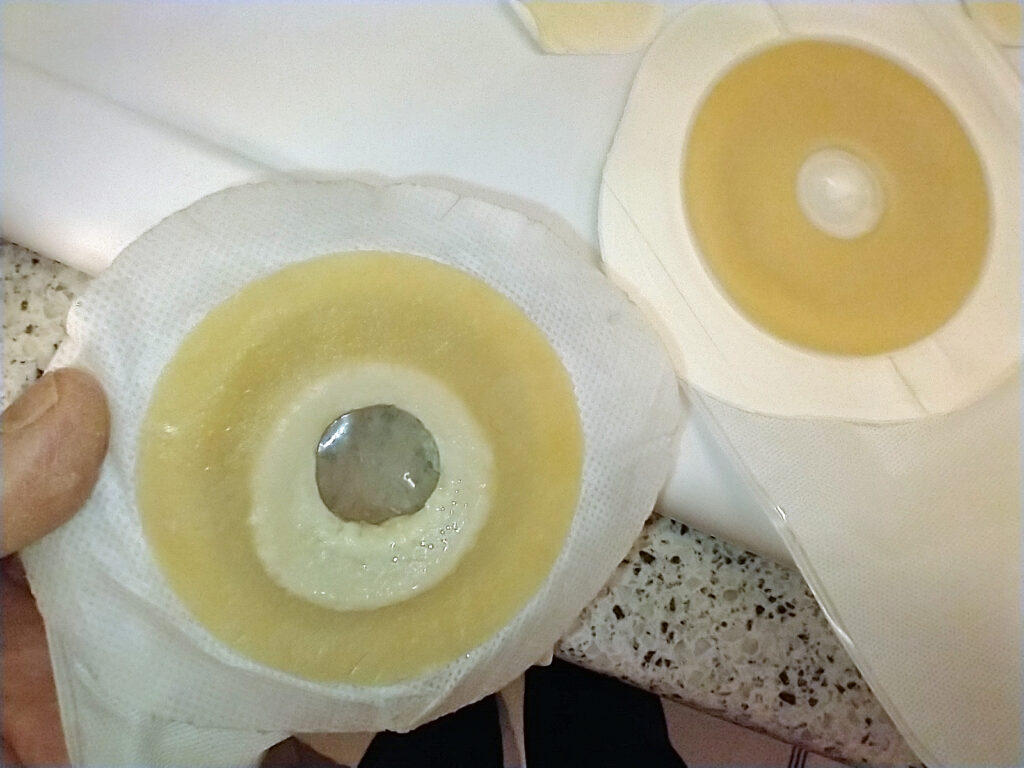
- Plan to change your appliance when your output is minimal. For many of us, that’s first thing in the morning before eating or drinking, or at least several hours after last eating or drinking.
- Follow medical advice to flush, clean, sanitize, and dispose of urostomy supplies and appliances on a regular schedule. I pour a mix of water and white vinegar (1:1) through my pouch adapter with a narrow funnel, or use a spouted condiment bottle to flush my night drainage hose daily (Figure 3). When traveling, I carry Polident peroxide denture cleaning tabs for that purpose, as it’s hard to pack a gallon of vinegar in luggage without raising suspicion. You can ask your doctor or stoma nurse If you don’t know how often to clean or replace your appliances. Many U.S. insurers follow Medicare guidelines for appliance replacement frequency.

- Take good care of the skin around your stoma. We won’t be comfortable if our skin is irritated. Most peristomal skin problems start with physical damage to skin cells (denudement), because of rough appliance removal or not using enough of the right kind of medical adhesive removers. With enough of the right remover between my skin and the wafer, my appliance almost falls off by itself. Just like when we were babies, waiting too long between changes invites irritation through skin exposure to urine and body waste.
- To protect yourself and others from infections, follow clean techniques whenever working around your stoma. Don’t expose your stoma to water that you would not drink, and don’t swim or soak in a tub without wearing your appliance. Wash your hands before and after toileting, or use hand sanitizer when soap and water isn’t available.
- Soap film and lotions are a preventable, but common, cause of leaking at the peristomal skin layer. Ostomy nurses recommend using only clean water or specially made peristomal wipes for cleaning around the stoma. Many ostomates like showering with Head & Shoulders original “Classic” shampoo with zinc pyrithione. However, formulas change, so read the label and pay attention to skin condition and adhesion.
- Dispose of soiled products safely in sealed bags provided by your supplier or use “doggie-do” bags.
- Consider testing your own urine before calling your doctor about a suspected urinary tract infection. I test my urine after a fresh pouch change for leukocyte activity, nitrite, blood, and more with the same type of urine dip sticks that I’ve seen in clinical labs. While they won’t conclusively tell me that I need antibiotics, they can provide useful information to communicate to my doctor. I don’t need to test frequently, so I only order a small number of individually wrapped test strips. Extended exposure to air or moisture causes false test results, so bulk containers of test strips are no bargain for most of us.
Disclaimer: The information shared by Ostomy Canada Society is for educational purposes only and is not a substitute for professional medical advice, diagnosis, or treatment. Every person’s ostomy experience is unique. Please consult your health care provider with any questions about your condition, care, or treatment plan.
